

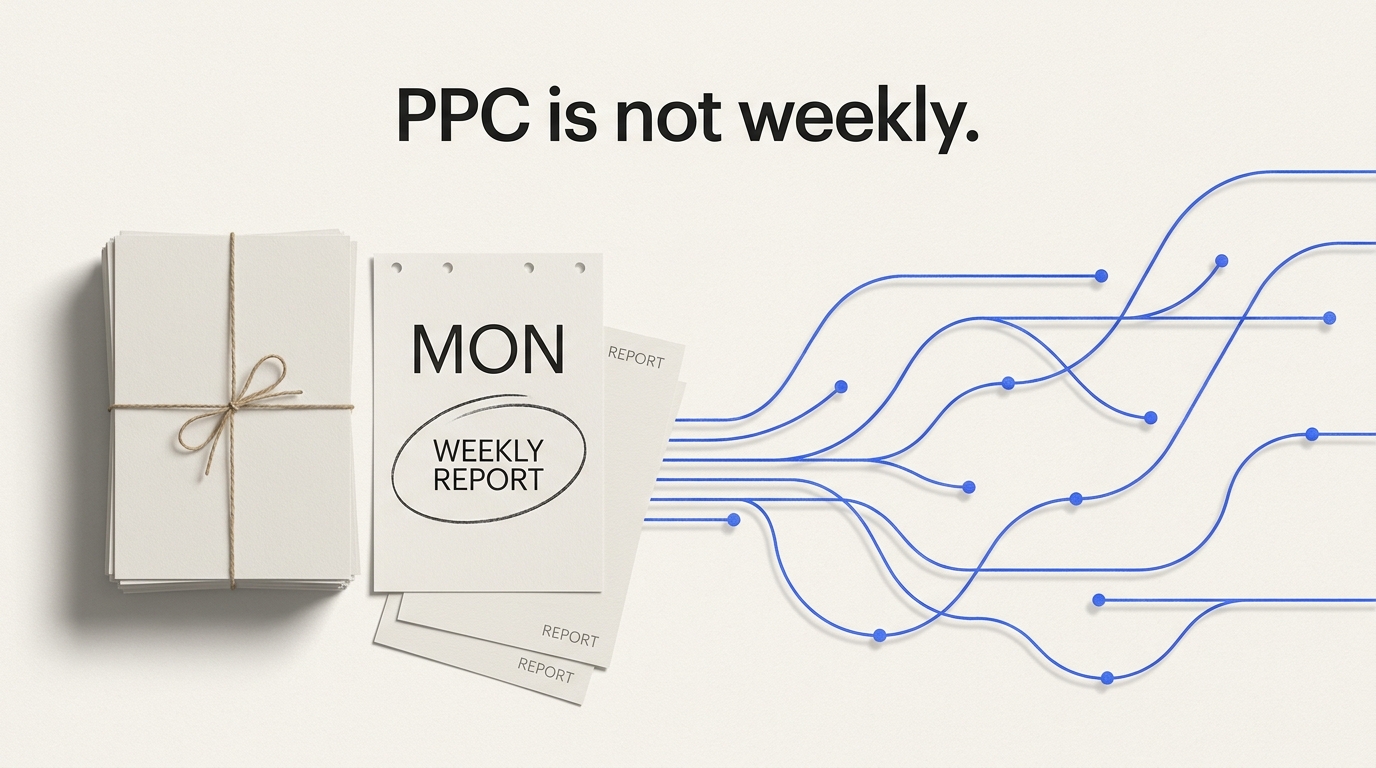
Amazon PPC management is no longer a weekly reporting task. Campaigns move daily. CPCs drift, conversion rates change, budgets leak, and search terms decay. The new workflow is always-on monitoring with human-approved actions.
Amazon PPC management used to be simple enough to run as a weekly routine.
Pull the reports. Check spend. Adjust bids. Add a few negative keywords. Move winners from automatic campaigns into manual campaigns. Look at ACoS. Repeat next week.
That workflow made sense when an account had a small number of products, campaigns, and search terms. It does not hold up once a brand starts scaling.
The problem is not that sellers lack data. Amazon sellers have more data than ever. They have search term reports, placement data, campaign reports, budget data, ACoS, ROAS, CTR, CPC, CVR, TACoS, inventory context, and margin constraints.
The problem is that nobody acts on all of it fast enough.
The Old Workflow Was Built Around Human Attention
Traditional Amazon PPC management depends on a person remembering to look.
A manager opens a report. They scan rows. They notice wasted spend. They spot a keyword that should be negated. They see a campaign that is pacing too fast. They make a few changes. Then the account waits until the next review.
That is not really a system. It is a calendar habit.
And calendar habits break when the account gets larger.
One brand might have 20 SKUs, each with Sponsored Products campaigns, Sponsored Brands campaigns, exact match keywords, phrase match keywords, broad match keywords, product targeting, defensive campaigns, branded campaigns, launch campaigns, and ranking campaigns.
One agency might manage this across 50 brands.
At that point, the work does not grow in a straight line. It compounds.
Every new product creates more campaigns. Every campaign creates more search terms. Every search term creates more possible decisions. Every decision has context.
Should this term be negated? Should this bid be cut? Should this budget move? Is ACoS high because the term is bad, or because the product is in launch mode? Is conversion down because the listing is weak, or because inventory is low, or because the Buy Box was lost?
A weekly review cannot carry that much context.
The Problem Is Slow Action
Most PPC waste is not dramatic.
It is small drift that compounds.
A CPC rises. A conversion rate falls. A budget drains early. A search term spends through the threshold without converting. A strong keyword loses impression share. A product runs low on stock while campaigns keep pushing traffic.
None of these issues need a strategy meeting.
They need fast detection, clear reasoning, and a specific next action.
The old workflow catches many of these issues late. By the time the report is reviewed, the spend has already happened. The missed sales are gone. The wasted budget has already moved through the account.
This is why Amazon PPC management has changed.
It is no longer enough to be good at bid changes. The better question is: how fast is your feedback loop?
Four PPC Problems That Do Not Wait for Friday
The first problem is CPC spikes.
A keyword can become more expensive before a human notices. If conversion rate stays flat, profit drops. If conversion rate also falls, the campaign can burn money quickly.
A weekly review sees the average. A monitoring system sees the change.
The second problem is conversion drops.
A campaign can look healthy for weeks, then suddenly stop converting. The cause may not be the keyword. It could be price, reviews, inventory, Buy Box loss, a competitor move, or a listing issue.
Cutting bids blindly can protect ACoS but hide the real problem.
The third problem is budget leakage.
Budgets do not only need to be set. They need to be paced. A campaign can spend too early in the day, too early in the week, or too aggressively against weak terms.
By the time someone checks the account, the budget may already be gone.
The fourth problem is search term waste.
Search terms are where account quality shows up. A few bad terms can quietly drain spend. A few good terms can deserve more budget. The search term report tells you this, but only if someone reads it often and turns it into action.
Most sellers do not need more reports.
They need the report to become a workflow.
Rules-Based Automation Helps, But It Is Not Enough
Rules are useful.
A rule can lower a bid when ACoS crosses a threshold. A rule can pause a keyword after enough spend without sales. A rule can raise a budget when a campaign performs well.
But rules are narrow by design.
They know the condition you gave them. They do not always know the business context.
A keyword with high ACoS may still matter if it supports organic rank for a strategic product. A campaign that looks profitable may still be a bad use of budget if the product has low inventory. A term with no conversions may deserve more time if the price just changed. A bid cut may improve ACoS while hurting TACoS.
This is the limit of simple automation.
It can move quickly, but it can also move without judgment.
That is why the next step is not full autopilot. It is an agent workflow with human approval.
The Better Model: Agents Monitor, Humans Approve
Modern Amazon PPC management should work like a control system.
The system watches the account every day. It detects meaningful changes. It explains what changed. It proposes a specific action. It shows the risk. Then a human approves or rejects it.
That flow matters.
The agent should not just say, "ACoS is high." It should say:
- Which campaign changed.
- Which keyword or search term caused it.
- What metric moved.
- Why the movement matters.
- What action is recommended.
- What could go wrong.
Then the human decides.
This keeps the seller in control while removing the manual scanning work.
The human should make judgment calls. The system should do the watching.
What Amazon PPC Management Should Look Like Now
A better PPC management workflow has eight parts.
- Always-on monitoring: Campaigns are checked continuously, not only during a weekly review.
- Search term triage: Waste, winners, and new patterns are flagged quickly.
- Budget pacing checks: Campaigns are watched for early spend, under-spend, and budget mismatch.
- Bid recommendations: Bid changes are proposed with context, not made blindly.
- TACoS-aware decisions: Campaign changes are judged against total sales, not only ad efficiency.
- Inventory-aware decisions: The system knows when traffic should slow down because stock is constrained.
- Approval queue: Humans see proposed actions in one place.
- Audit trail: Every recommendation, approval, and result is logged.
This is different from hiring another analyst.
An analyst still has to choose what to check. An always-on system checks everything it is told to watch.
This is also different from a simple rules engine.
A rules engine reacts to thresholds. An agent workflow explains context and asks for approval.
Why This Matters for Agencies
Agencies feel this pain first.
A seller with one brand may be able to patch the workflow with discipline. An agency managing 50 brands cannot rely on memory, spreadsheets, and weekly review calls forever.
Each new client adds reporting, exceptions, bid decisions, budget decisions, search term reviews, and follow-up work.
The agency either hires more analysts or accepts slower action.
That is the analyst ceiling.
The way through it is not to remove humans. It is to stop using humans as the monitoring layer.
Let software watch the account. Let agents prepare the work. Let humans approve the important decisions.
The Bottom Line
Amazon PPC management is not a report.
It is a feedback loop.
The faster the loop, the less waste compounds. The clearer the recommendations, the less time the team spends digging. The stronger the approval process, the more confidently a brand can scale.
Weekly PPC reviews are not dead. They are just no longer enough.
The new workflow is always-on monitoring, clear recommendations, and human-approved execution.
Ready to scale your Amazon brand without adding headcount? Sign up to use Clair's autonomous agents to monitor PPC, propose actions, and keep you in control.