

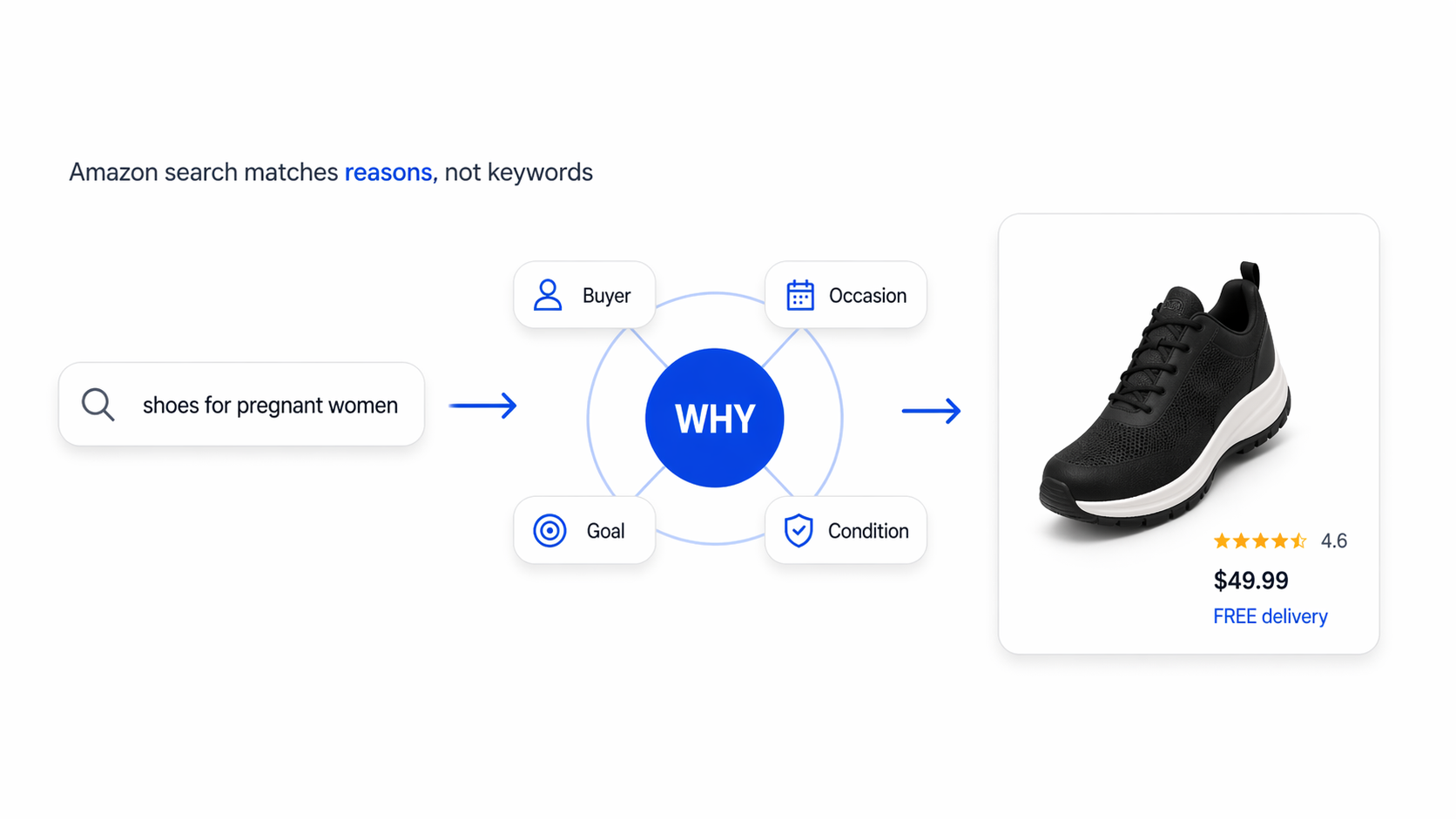
Amazon's search doesn't match keywords to products anymore. It matches reasons to products. We read the paper and reverse-engineered the algorithm so you can optimize your listings for it.
In early 2024, Amazon's science team published a paper titled COSMO: A Large-Scale E-commerce Common Sense Knowledge Generation and Serving System at Amazon. It detailed a massive architectural shift in how the A9 search algorithm functions, moving from lexical matching to an intent-driven knowledge graph.
Amazon's search doesn't match keywords to products anymore. It matches reasons to products.
The Problem with Old Search (Lexical Matching)
Historically, Amazon relied heavily on lexical matching using systems like BM25. It looked at the keywords a user typed and found listings with those exact words. It knew a jacket was a jacket, but it failed at context.
Here's why that matters.
Someone searches "shoes for pregnant women." They ultimately buy a pair of slip-resistant shoes. Under the old system, if the keyword "slip-resistant" never appeared in their search query, those shoes might not rank. But that's exactly what the customer needed: pregnant women need grip. They aren't searching for the physical feature of slip-resistance, they are searching for a solution to a pregnancy-related need.
The old system missed this connection because it couldn't map the intent. The new one doesn't.
How COSMO Works
Amazon built COSMO by feeding over 5 million real shopping sessions into a Large Language Model (LLM). They tracked every search that ended in a purchase and every pair of items bought together in the same cart. For each session, they asked the AI one question: "Why did this customer buy this?"
From 5 million answers, they built a "Common Sense" knowledge graph. A massive, multi-dimensional map of WHY people buy things on Amazon. That map now runs inside Amazon's search engine, actively translating what people type into what they actually mean.
The Technical Architecture: From Massive LLMs to Production Scale
For the technical readers, the actual engineering of COSMO is fascinating because it solves a classic machine learning bottleneck: how do you run expensive, heavy language models on billions of searches with zero latency?
Amazon didn't just deploy ChatGPT to their search bar. They used a multi-stage distillation process:
- Instruction Generation (The Teacher): Amazon first used massive, state-of-the-art LLMs (the paper implies models similar in scale to GPT-4) purely as offline analysts. They fed these teacher models millions of data points showing what people searched for, what they clicked, and what items were bought together.
- Knowledge Extraction: The teacher model analyzed the behavior and spit out structured text connecting products to human intents (e.g., mapping "running shoes" + "knee brace" to the intent "joint support during cardio").
- Fine-Tuning COSMO-LM (The Student): Amazon then took this structured intent data and used it to fine-tune much smaller, highly efficient models based on the open-source LLaMA architecture (specifically 7B and 13B parameter models). These fine-tuned "student" models are called COSMO-LM.
- By teaching a small, fast model to mimic the common-sense reasoning of a massive, slow model, Amazon achieved sub-millisecond latency. They successfully scaled COSMO-LM to handle production traffic across 18 e-commerce domains, mapping 15 distinct relation types across 5 different search and recommendation tasks.
The 15 Dimensions of Intent
The COSMO knowledge graph maps intent across 15 distinct dimensions. Here are the ones that matter most for your listings:
- Who uses it: The specific audience identity (pregnant women, new runners, dog owners).
- What they're trying to do: The activity or goal (walking the dog, setting up a home office).
- What event it's for: Occasions like weddings, morning workouts, or road trips.
- Where they use it: Locations such as the bedroom, backyard, or gym.
- What body situation it solves: Contextual physical states like sensitive skin, blisters, or back pain.
- What they pair it with: Products frequently bought together (a camera case and a screen protector both solve the intent of "device protection").
Amazon fills these 15 boxes for every product on the platform automatically, using real purchase behavior. Your listing didn't teach it. Customer behavior did.
But here's the thing: your listing content either confirms or contradicts what the behavior data says. And when the two disagree, the model's confidence drops.
Two Sellers. Same Jacket. Different Listings.
Here's what this looks like in practice. Let's look at two sellers offering the exact same waterproof jacket.
Seller A writes: "100% recycled polyester. Water-resistant coating. Available in 4 colors. Machine washable."
Amazon reads this and maps it lexically. It's a jacket, it's water-resistant, it's made of polyester. Zero intent signals.
Seller B writes: "Built for dog owners who walk in all weather. Stays dry on early morning walks, rainy commutes, and muddy trail days. Light enough to move freely. Pairs well with waterproof boots."
Amazon reads this and successfully maps it to the COSMO graph: audience (dog owners), activity (walks, commutes, trails), condition (rain, mud), pairing (boots), occasion (morning, daily). Five direct intent signals from one paragraph.
Both jackets are identical. Seller B is more discoverable when someone searches "jacket for walking dog in rain", even if those exact words never appear in Seller B's backend terms.
The Financial Impact of Intent
According to the Amazon Science blog, implementing this intent layer resulted in a 0.7% conversion increase across 10% of their US traffic via the new navigation refinement filters alone. The paper explicitly states this translated to hundreds of millions of dollars in previously uncaptured revenue.
If you aren't optimizing your listings for intent, you are bleeding market share to competitors who do.
How Clair Automates COSMO Optimization
Auditing your catalog against a 15-dimension intent matrix is an operational nightmare to do manually. You have to scrape search term reports, cross-reference them with customer reviews, and rewrite copy without breaking your existing keyword ranks.
This is where Clair's crew of specialized agents changes the game. You don't just get a keyword tool; you get a team that actively maps your ASINs against the COSMO knowledge graph and executes the updates safely.
- Clair routes the brief: You drop a task (e.g., "Optimize SKU-119 for intent gaps") and set your rules. Clair instantly routes the work to the right specialists.
- Maya maps the gaps: Maya analyzes your synced search performance and indexing data. She identifies the high-volume intent terms you are missing, while explicitly protecting the top existing keywords that are already driving sales.
- Leo drafts the rewrite: Leo takes Maya's data and drafts a byte-perfect, category-compliant rewrite. He naturally weaves the new audience, activity, and location signals into your title, bullets, and backend terms without violating Amazon's strict style guides.
- Luca ships it: You review Leo's clean visual diff. Once you click "Approve," Luca pushes the update directly to Seller Central. And if conversions drop next week? You have a one-click rollback to the exact previous version.
Your Action Plan
If you aren't using Clair yet, you need to audit your listings manually today. Answer these five questions in your copy:
- Who IS the buyer? Not "adults 25-45." A real identity: new mom, dog owner, home baker, beginner runner.
- What are they trying to DO? The goal or activity, not the product feature. Not "waterproof." But "stay dry while walking the dog."
- What occasion or event? Morning routine, camping trip, work from home, wedding season.
- What do they pair your product with? What else do your customers buy in the same order? Name it. Seed that co-purchase signal.
- What situation or problem does it solve? Not features, the real-life condition. Blisters from long days. Back pain from bad chairs. Sensitive skin from harsh weather.
Add this language to your title, bullets, description, and backend search terms naturally. COSMO is reading every field.
Your listing isn't just a sales page. It's the annotation layer that helps Amazon's AI understand what your product is actually for.